Guidelines on the Standards for Argumentation on Social and Scientific Issues
The guidelines presented on this page are available as a PDF file: here.
Argumentation is a process through which individuals construct, justify, question, and/or evaluate statements (which may express viewpoints or emotions, draw on knowledge, etc.). Argumentation can be viewed as a social practice—intrinsically dialogic and based on a set of norms.
1. General Standards for Argumentation
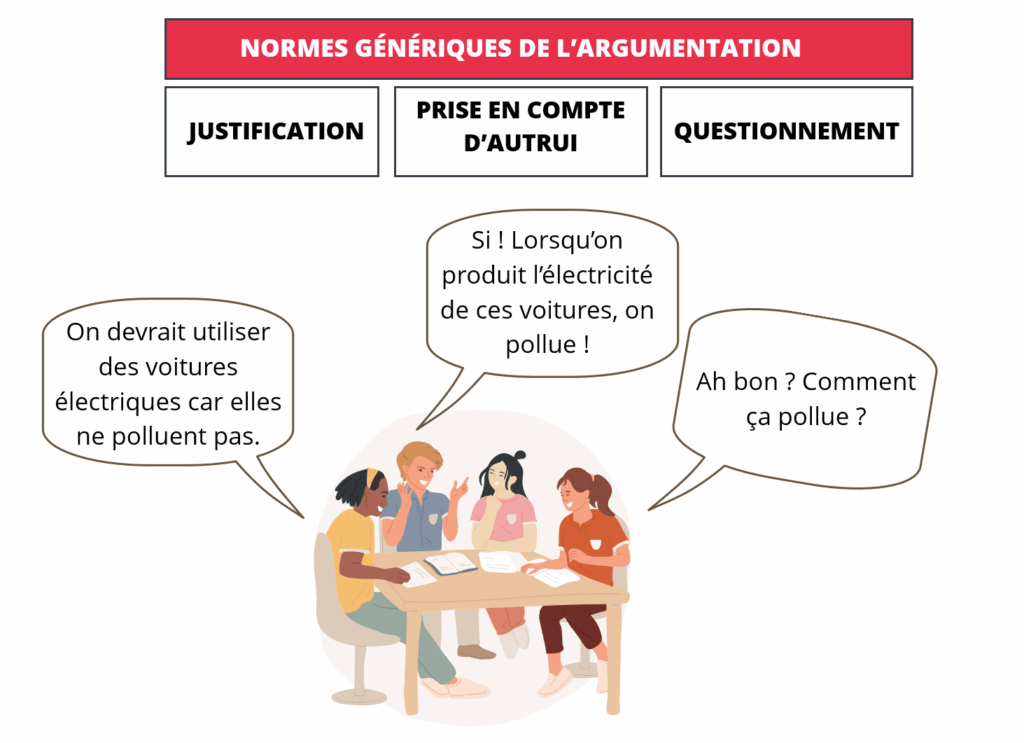
Argumentation is governed by standards that define what constitutes a good argument. These standards may be general or specific to the context in which the argument is developed. Three general standards are particularly important and deserve to be addressed in an educational setting: justification, consideration of others, and questioning.
1.1. The Standard of Justification
Every claim must be supported by justifications, which are reasons for accepting the claim. These justifications can take several forms: reliance on empirical data (experiments, observations, etc.), consistency with established knowledge, reference to a source, alignment with values, testimonials, and so on. Justification is essential for transforming a simple claim into a valid argument.
1.2. The “consideration for others” standard
Argumentation is a dialogic process in which the arguments and viewpoints of other participants must be taken into account. This involves developing, refuting, or qualifying the viewpoints of others, which helps to enrich the argument.
1.3. The Questions
Questioning and challenging statements—whether they come from others or from oneself—is a driving force behind argumentation. It is what prompts us to examine the justifications put forward and to consider counterarguments, in order to strengthen or adjust our position.
2. Standards specific to the context of socio-scientific issues (SSI)
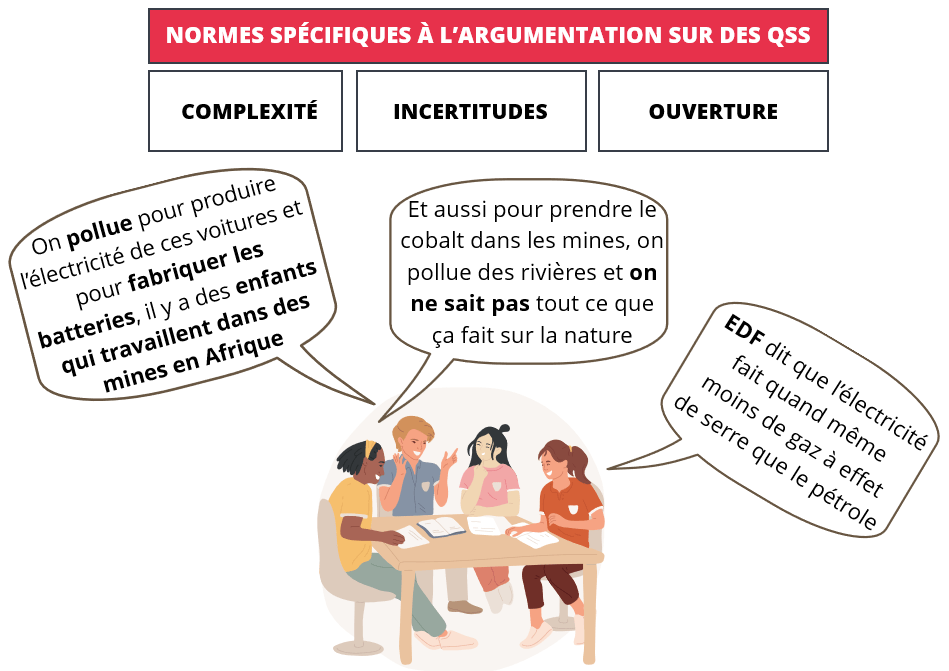
We can distinguish between purely scientific questions and socio-scientific questions (SSQs), the latter of which can be defined as societal questions that involve science and/or technology. These two types of questions draw on specific standards of argumentation. In the case of the experimental sciences, two standards prevail: justification through empirical evidence and consistency with already established theories, models, or laws. SSQs call for other types of justifications, incorporating ethical, social, political, or other dimensions. Here are a few examples of SSQs: Should new nuclear power plants be built? Should electric cars be made mandatory? Should we ban glyphosate in agriculture? Argumentation on these issues must adhere to three specific standards: complexity, uncertainty, and openness.
2.1. Standard complexity
QSS encompasses multiple dimensions—not only scientific and technical, but also axiological (related to values), economic, educational, environmental, experiential, political, health-related, and social. An argument that integrates and links these various dimensions enables a comprehensive understanding of QSS.
2.2. Uncertainty Standards
The knowledge used in QSS involves uncertainties. It is important to distinguish between two types of uncertainty: uncertainties related to knowledge, which concern what science does not yet know or what remains to be discovered, and uncertainties related to the changing world, which refer to future changes in areas such as climate, society, or technology—changes that cannot be accurately predicted. Both types of uncertainty are to be expected in high-quality reasoning.
2.3. Standard opening
QSSs are open-ended questions that allow for multiple perspectives and possible answers. The argument must acknowledge the diversity of legitimate viewpoints, which reflect the values and interests of various stakeholders in society, such as business leaders, representatives of organizations, parents, and so on.
2.4. Interconnection of Specific Standards
The three specific criteria (complexity, uncertainties, openness) are interconnected. The complexity of a QSS reinforces its open nature, as societal actors may prioritize different dimensions (for example, the environmental dimension or the economic dimension). Similarly, the uncertainties inherent in QSSs make alternative viewpoints acceptable, which further reinforces their open nature.
For more information:
Bächtold, M., Pallarès, G., De Checchi, K., & Munier, V. (2023). Combining debates and reflective activities to develop students’ argumentation on socioscientific issues. Journal of Research in Science Teaching, 60(4), 761–806. https://doi.org/10.1002/tea.21816
Clark, D. B., & Sampson, V. (2008). Assessing dialogic argumentation in online environments to relate structure, grounds, and conceptual quality. Journal of Research in Science Teaching, 45(3), 293–321. https://doi.org/10.1002/tea.20216
Garcia-Mila, M., & Andersen, C. (2007). Cognitive foundations of learning argumentation. In S. Erduran & M. Jiménez-Aleixandre (Eds.), Argumentation in science education (pp. 29–45). Springer Science + Business Media.
Jiménez-Aleixandre, M. P., & Erduran, S. (2007). Argumentation in science education: An overview. In S. Erduran & M. P. Jiménez-Aleixandre (Eds.), Argumentation in science education (pp. 3–28). Springer.
Osborne, J., Erduran, S., & Simon, S. (2004). Enhancing the quality of argument in school science. Journal of Research in Science Teaching, 41(10), 994–1020. https://doi.org/10.1002/tea.20035
Pallarès, G., Bächtold, M., & Munier, V. (2020). Can Digital Debates Help Develop Students’ Argumentation Skills on Social and Scientific Issues? Research in Science and Technology Education, 22, Online article. https://doi.org/10.4000/rdst.3573
Pallarès, G., De Checchi, K., & Bächtold, M. (2023). What Teaching Approach for “Critical Thinking”? An Approach Based on the Standards of Critical Argumentation on Socio-Scientific Issues. Research in Science and Technology Education, 28, Online article. https://doi.org/10.4000/rdst.5221
Plantin, C. (2016). Dictionary of Argumentation: An Introduction to Argumentation Studies. ENS Éditions.
Polo, C. (2014). “Mouth-watering: Students’ Argumentative Resources and Strategies in Socio-Scientific Debates on Drinking Water” [Doctoral dissertation, Lumière Lyon 2 University].