AREN Instructional Sequence
The guidelines presented on this page are available as a PDF file: here.
Research has shown that repeated debate practice promotes the development of argumentation skills and that these skills are further strengthened when debates are combined with reflective activities focused on the arguments presented by students (see the Guidelines on Student Learning in Argumentation). As part of the AREN-DIA project, a team of researchers in education, linguistics, and psychology, in collaboration with a group of teachers, designed instructional units centered on a digital classroom debate on socio-scientific issues (SSI), the general structure of which is outlined below.
A. General Structure of an AREN-DIA Teaching Sequence
The teaching sessions consist of three phases: a preparatory phase, a discussion about AREN, and a reflective activity.
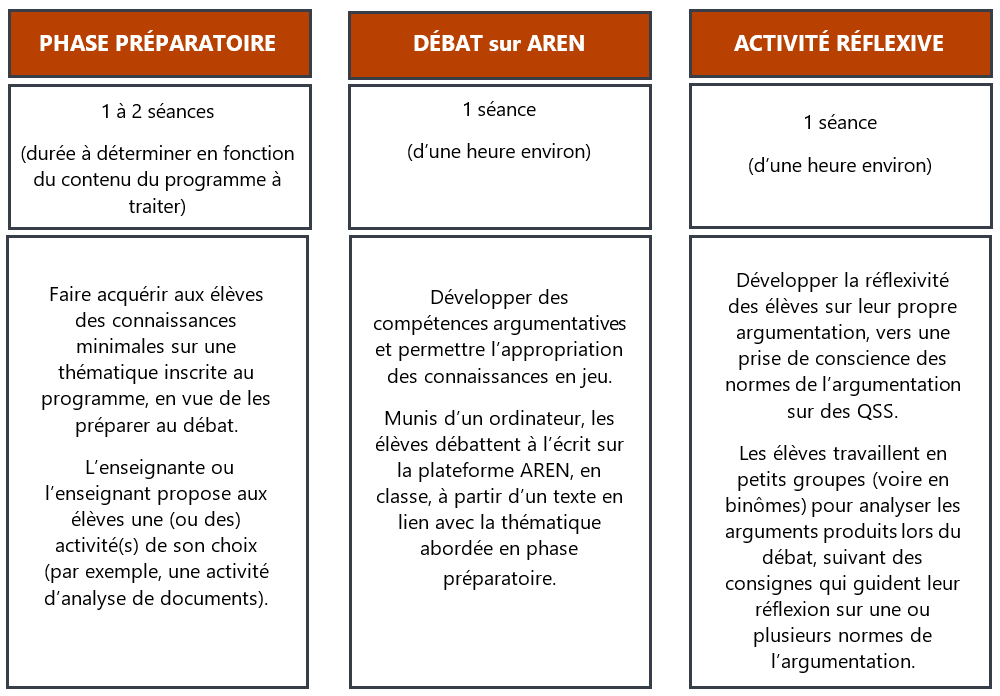
B. The Three Phases of the AREN-DIA Instructional Sequence
Now, let’s describe in more detail each of the three phases of this teaching sequence, which is intended for teachers of various subjects (French, history and geography, philosophy, physics and chemistry, life and earth sciences, etc.).
Preparatory Phase
The teacher begins by identifying the knowledge and skills to be developed, as well as the instructional objectives for the lesson sequence. The teacher can draw on their usual teaching resources and may propose one or more activities that serve the dual purpose of covering part of the curriculum and preparing students for the discussion that will follow.
Before the first debate, it is also an option to ask students to work together to create a debate charter. It could include rules such as:
- Be respectful and polite to other students
- Take the time to read what other students write
- Stay on topic; don't talk about anything else
- Use a tool to ask for help (such as “tréta’aide,” for example, which allows students to ask for help without raising their hand or going to the teacher’s desk)
Debate on AREN
Once the topic has been introduced, the teacher dedicates a class session to a discussion on the AREN platform. To do this, the teacher provides students with a text related to the topic, incorporating various elements likely to spark a debate. It is recommended to use a short text, which could be a news article, an excerpt from a book, a website excerpt, or a compilation of articles. To ensure the text is appropriate for the students, the selected excerpt can be shortened, and certain complex words can be replaced or accompanied by a definition (alternatively, complex words can be defined or clarified verbally). It is also recommended that the text present conflicting viewpoints. It should include several arguments while remaining accessible to the students.
It is essential to show students how to use the platform before asking them to discuss the text online. To do this, the teacher can give a live demonstration in class or show them our video tutorial [link to the user tutorial] available on our website.
On the day of the debate, each student has access to a computer and logs in to the AREN platform ( if that’s not possible, students can also work in pairs on one computer). Students click on the debate thumbnail indicated by their teacher.
The teacher can review the text with the students and clarify any points they did not understand. This type of review is more common in middle school than in high school. The teacher then provides instructions for the debate. In this regard, it is worth noting that a debate can be (more) persuasive or (more) cooperative[1]. As part of the AREN-DIA project, we favor cooperative debates, which are more consistent with the functioning of a deliberative democracy[2] [insert footnote: definition], in which we aim to educate our students. With this in mind, the guidelines might be as follows:
- collectively explore the ideas presented in the text in an effort to understand them;
- discuss them, ask questions about them;
- compare your points of view by presenting arguments;
- and if there are disagreements among the students, try to understand them and resolve them.
Before or during the discussion, the teacher can explain to the students that they can take turns responding to passages from the text or to other students’ comments.
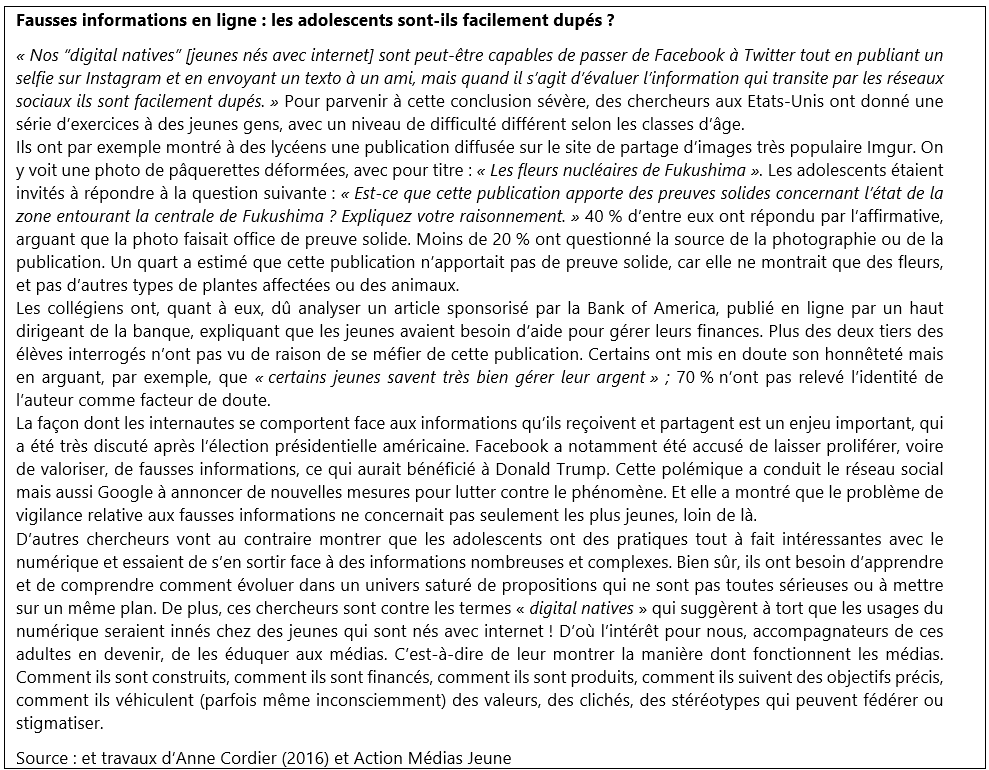
As an example, here is a text for discussion proposed in 2023 by researchers and a French teacher (see a collection of texts for discussion in middle and high school):
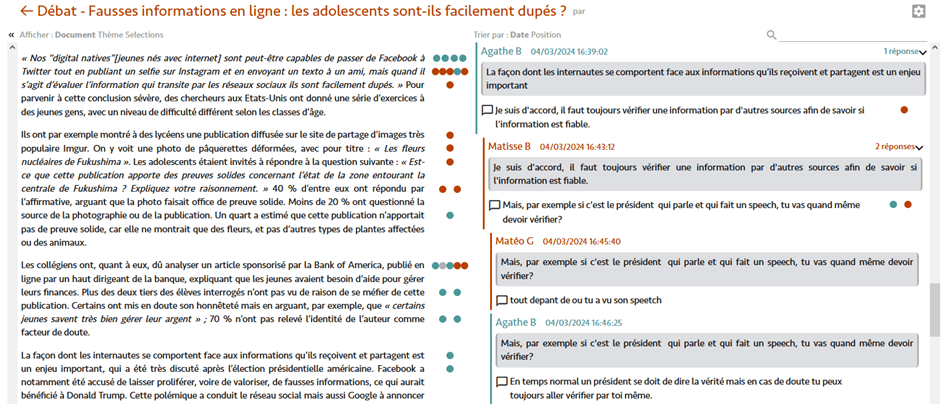
Here is an example of a discussion thread on AREN based on this text:
Reflective Activity
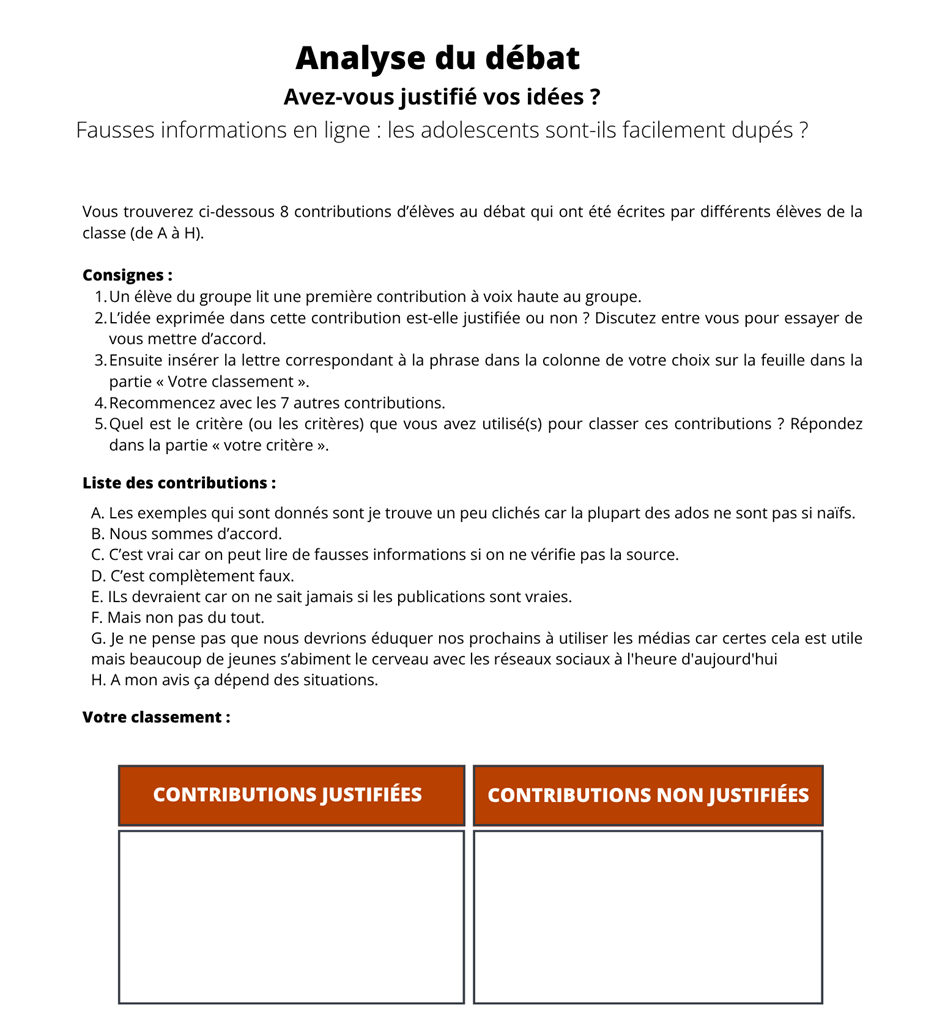
In the session following the online debate, the teacher asks the students to complete a reflective activity based on the debate’s outcomes (see the more detailed description of several Reflective Activities). This activity may focus on one or more standards for argumentation regarding social science questions (see the Guidelines on Standards for Argumentation on Social Science Questions). In the case of our example, the French teacher focused here on the justification standard; she therefore seeks to make students aware of the importance of providing justification and to help them identify simple criteria for recognizing and defining what constitutes a justification. She selects student contributions from the debate—both those with and without justifications—to design her activity.
[1] In a persuasive debate, each participant presents arguments with the goal of convincing others to adopt their point of view on the issue under discussion. In a cooperative debate, participants present their arguments with the goal of learning from one another and helping each other form their own views on the issue under discussion. This second type of debate is more likely to lead to a consensus.
[2] Deliberative democracy is a form of democracy that places deliberation at the heart of the collective decision-making process. Deliberation involves comparing, examining, and debating the viewpoints, interests, and arguments of all citizens; it provides an opportunity to learn from one another, engage in collective reflection, and revise one’s views; it enables the formation of shared opinions and, ideally, leads to the fairest possible collective decisions.