Conference: “Improvising Teaching, Teaching Improvisation”
Faculty of Education, Place Marcel Godechot, 34000 Montpellier.
By placing improvisation at the heart of discussions, practices, anddiscussions, this conference aims to critically examine not only methods of teaching, training, and coaching, but also processes of learning and development.
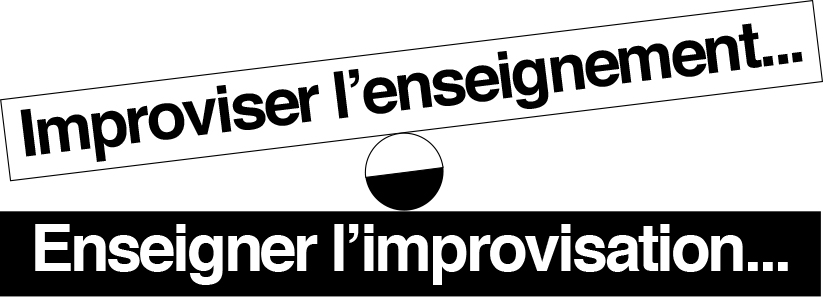 The IEEI Organizing Committee has confirmed that the conference will take place. It will be held in person on June 16 and 17. Given the international and national health situation, one keynote speaker and a few presenters will nevertheless deliver their presentations remotely (from Quebec, Switzerland, Lebanon, etc.).
Theme of the 2021 IEEI Conference
Improvisation? This concept is commonly associated with the arts. But it also extends to other fields of practice and research, such as medicine, the legal profession, defense, civil security, crafts, sports, and teaching, learning, and training. It is worth noting that the term regularly appears in the vocabulary of many practitioners (often outside established professional frameworks) or in that of certain work analysts. The concept can reflect a form of practical reality, viewed as more or less acceptable or unavoidable; it can also be used to point the finger at questionable amateurism or, conversely, to sing the praises of experts and virtuosos. The disparity in the varying degrees of regard for improvisation raises questions.
Does the classic dichotomy between the “mythical valorization” and “critical devaluation” of improvisation (De Raymond, 1980)—or the equally common dichotomy pitting structure against spontaneous outpouring—constitute a heuristic opportunity or an obstacle? What isthis praxisknown as improvisation? Is it an experience, a distinct activity? Are there conditions under which we can speak of improvisation? To what extent can improvisation be linked to imagination and/or creation and/or intuition and/or invention, etc.? Can improvisation and adaptation be conflated? Is it preferable to distinguish between them? How does improvisation function in terms of interaction, attention, sensibility, or cognition? What is the relationship between improvisation and preparation? Can improvisation be considered a form of emancipation? Is improvisation primarily an individual or a collective practice? Is improvisation solely the domain of experts? Or is it part of the conditions that give rise to expertise? Can it be viewed as a path to becoming—and remaining—a professional? Should we consider that one must learn in order to improvise, or improvise in order to learn? Can one learn to improvise? Etc. These are just some of the questions that will be explored throughout this conference.
Laborde (2005) describes the practice of improvisation as an art of memory and the moment (a practice that is at once embodied, cultural, and sublimated through the contextual relationship with the other). Pierrepont (2009), regarding collective improvisation, identifies a set of four specific properties: it is propositional, situational, immanent, and consists of a combinatorial and transformative dynamic. Hennion (2018) considers that improvisation is best understood not only from the perspective of the improviser (who acts, and acts in order to let things happen) but also—extending Souriau’s work and adopting a pragmatist viewpoint—from the perspective of the work itself (which both comes into being on its own and is yet to be created—in its perpetual unfolding, it is thus possible and relevant to view it as being supported in a distributed manner, not only by the improviser but also by other participants in the interaction, such as the audience). Anthropologists and sociologists have thus proposed fruitful hermeneutics of improvisation. This is also the case with other researchers such as Mouëllic (2011), who, in his book *Improviser le cinéma*, argues, among other things, for a form of continuity between writing (a certain kind of writing) and improvisation during filming, or Citton (2014), who, in an essay, draws parallels between co-attentional dynamics and improvisation, as well as the agency of the collective attentional ecosystem that, in his view, a classroom constitutes.
In the field of research in education and training sciences, pedagogy, and didactics, improvisation is used in a variety of ways. For more than 40 years, this concept has been employed to describe and understand classroom interactions and their dynamics (e.g., Erickson, 1982; Gershon, 2006; Sawyer, 2004), to shed light on how students learn (e.g.,Baker-Sennett & Matusov, 1997) and how teachers teach (e.g., Borko & Livingstone, 1989; Perrenoud, 1994; Tochon, 1993), to understand teachers’ work (Azéma, 2019), to study and transform their professional development (e.g.,Pelletier & Jutras, 2008), or to discuss specific learning situations and analyze their implications (e.g., Gagnon, 2011). It is clear that the term encompasses different realities, multiple meanings, and sometimes contradictory viewpoints, which, in this sense, contribute to diverse understandings.
Today, teachers, instructors, and coaches are constantly seeking insights into their practices, as well as ways to improve their effectiveness. Learning and development processes are being reexamined, particularly through the lens of neuroscience. In this context, it is essential to continue describing and understanding the forms of educational interactions—whether in the classroom, in training and professional development, or in coaching and performance capacity. Similarly, it is crucial to continue exploring the dynamics of individuation (Simondon, 2013) among those involved in teaching, education, training, and coaching. By placing improvisation at the center of reflections, practices, and debates, this conference aims to critically examine not only methods of teaching, training, and coaching, but also processes of learning and development.
Bibliographic references:
- Azéma, G. (2019). Improvisation and the Day-to-Day Work of New Teachers. What Kind of Activity? What Are the Challenges?*Activités*[Online], 16-1 | 2019, published online on April 15, 2019, URL: http://journals.openedition.org/activites/3941
- Baker-Sennett, J., & Matusov, E. (1997). School “performances”: Improvisational processes in development and education. In R. K. Sawyer (DS.),*Creativity in Performance*(pp. 197–212). Greenwich, CT: Ablex Publishing Company.
- Borko, H., & Livingston, C. (1989). Cognition and improvisation: Differences in mathematics instruction by expert and novice teachers.*American Educational Researcher*, 26(4), 473–498.
- Citton, Y. (2014).Toward an Ecology of Attention. Paris: Seuil.
- De Raymond, J.-F. (1980).*Improvisation*. Paris: Vrin.
- Erickson, F. (1982). Classroom discourse as improvisation: Relationship between academic task structure and social participation structure in lessons. In L.C. Wilkinson (DS.),*Communicating in the Classroom*(pp. 153–181). New York: Academic Press.
- Gagnon, R. (2011). “Theatrical Improvisation as a Tool for Oral and Written Expression and Its Teaching.”Swiss Journal of Educational Sciences, 33(2), 251–265.
- Gershon, W. (2006). Collective improvisation: A theoretical lens for classroom observation.*Journal of Curriculum and Pedagogy*, 3(1), 104–135.
- Hennion, A. (2018). “The Object, Belief, and the Sociologist,”Transposition[Online], Special Issue 1 | 2018, published online on January 30, 2018, accessed on May 14, 2018. URL:http://journals.openedition.org/transposition/1673; DOI: 10.4000/transposition.1673
- Laborde, D. (2005).*The Memory of the Moment: The Sung Improvisations of the Basque Bertsulari*. Bayonne: Elkar.
- Mouëllic, G. (2011).Improvising Cinema. Crisnée: Yellow Now.
- Pelletier, J.-P., & Jutras, F. (2008). The Components of Active Improvisation Training in Managing Unforeseen Events in Secondary School Classrooms.McGill Journal of Education, 43(2), 187–211.
- Perrenoud, P. (1994). Teaching practice between regulated improvisation and improvisation. In P. Perrenoud (DS.),Training between Theory and Practice(pp. 21–41). Paris: L’Harmattan. (Article originally publishedin *Education et Recherche*, 1983, 2, 198–212).
- Pierrepont, A. (2009). Improvisational Games, Constructive Games. In A. Pierrepont and Y. Séité (eds.), Improvisation: Order and Disorder. Human and Social Phenomena (pp. 19–36).Journal of the Department of Literature, Arts, and Film. Paris Diderot University – Paris 7.
- Sawyer, R. K. (2004). Creative teaching: Collaborative discussion as disciplined improvisation.*Educational Researcher*, 33(2), 12–20.
- Simondon, G. (2013).Individuation in Light of the Concepts of Form and Information. Grenoble: Millon. (Original text, 1958).
- Tochon, F. V. (1993). The “improvisational” approach of the expert teacher.Revue des sciences de l’éducation, 19(3), 437–461.
Registration and Practical Information
- Registration opens on January 31, 2021
- Registration deadline: May 30, 2021
- Deadline for withdrawal (if the conference is held): May 14, 2021.
Everyone attending the conference (speakers, presenters, moderators, audience members…*) must register as a conference participant through the online registration system (below). This applies to authors, co-authors, and audience members.
Rates
- Researcher, faculty member, doctoral student (institutional rate).**: €80
- Professional (including educators, elementary and secondary school staff, mediators, coaches, etc.)**: 50€
- Student**: 30€
* Masculine nouns used to refer to people refer to both men and women.
** Excluding UM FDE students (staff and students of the host institution are exempt from registration fees)
The registration fee includes:
- participation in all of the activities offered;
- lunch;
- Coffee or tea and pastries served during the morning welcome and during breaks.
The registration fee does not include other meals, lodging, or the gala dinner.
Gala Dinner
- The price of the gala dinner at the Brasserie du Corum is 40€.
- Advance payment must be made at the time of online registration. There is a checkbox provided for this purpose.
Payment Terms
Registration fees may be paid either by credit card or by administrative payment order with a purchase order*.
* PLEASE NOTE! IF YOU ARE PAYING BY PURCHASE ORDER, after receiving the preliminary order form (generated automatically by the system upon completion of your registration process), have your unit’s administrator use this form to prepare your purchase order and send itto Laura Gervais.

Download:
- Preliminary Program (April 30, 2021)
- Workshop Schedule (Coming Soon)
- Program of Presentations (coming soon)
- Index of short and long abstracts (coming soon).
- Map and Partner Hotels
- Registration deadline: May 30, 2021.
- Deadline for withdrawal: May 14, 2021.
- Contact